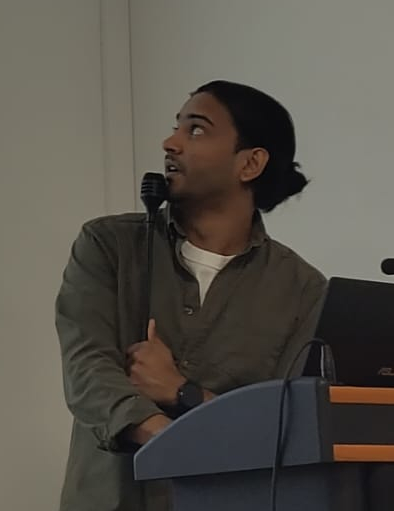
PhD successfully defended
Successfully defended my PhD, From Whistles to Communication: Toward a Computational Understanding of Dolphin Acoustic Signals, in front of a jury composed of Olivier Adam, Hervé Glotin, Laela Sayigh and Marcelo Rozenberg.
I am a postdoctoral researcher at the Institut de Biologie de l’École Normale Supérieure (IBENS), where I also completed my PhD (Université Paris Cité, 2026). I hold a Bachelor’s degree in Mathematics from Université Pierre et Marie Curie and a Master’s degree in Applied Mathematics (Statistics) from Sorbonne Université.
My research lies at the intersection of bioacoustics, animal communication, and machine learning. Using large-scale longitudinal acoustic datasets and self-supervised learning approaches, I investigate how dolphin vocalizations encode information about identity, social relationships, and interaction dynamics.
More broadly, I am interested in developing computational tools to uncover the principles underlying animal communication systems and their evolution. More recently, I have been contributing to the development of multimodal datasets combining acoustic recordings with behavioral annotations extracted from video data.
🔎 I am looking for my next position. I am seeking postdoctoral opportunities in computational bioacoustics, animal communication and machine learning for animal behavior, ideally starting around May 2027 (flexible: earlier or later start dates are possible). If you think my profile could fit your group, I would be happy to hear from you: get in touch.
Successfully defended my PhD, From Whistles to Communication: Toward a Computational Understanding of Dolphin Acoustic Signals, in front of a jury composed of Olivier Adam, Hervé Glotin, Laela Sayigh and Marcelo Rozenberg.
Our paper OpenWhistle was accepted as a spotlight paper at NeurIPS 2026 (top 1.3% of submissions).
Presented my work at the Neurosection Department Seminar, Institut de Biologie, ENS Paris.
Launched the citizen science project Dolphin Spotting on Zooniverse to collect behavioral annotations from dolphin video recordings.
Our paper Dolph2Vec was accepted at the AI for Non-Human Animal Communication workshop at NeurIPS 2025.
Awarded a 9-month PSL-Neuro PhD extension grant (Université PSL) to complete my thesis work.
Presented our research on dolphin communication to the general public at the Fête de la Science in Paris.
Gave a guest lecture on dolphin acoustic communication at Ben-Gurion University, Eilat Campus.
Started my PhD with a highly competitive doctoral fellowship (2–4 awarded each year out of around 200 applications) from the FIRE PhD program, funded by the Bettencourt Schueller Foundation and the EURIP Graduate School (Université Paris Cité).
F. Mustun*, C. Semenzin*, R. Dessì, P. Robin Guerrero, P. Orhan, A. Emanuelli, E. Rossi, Y. Lakretz, G. de Polavieja, G. Sumbre.
* Equal contribution
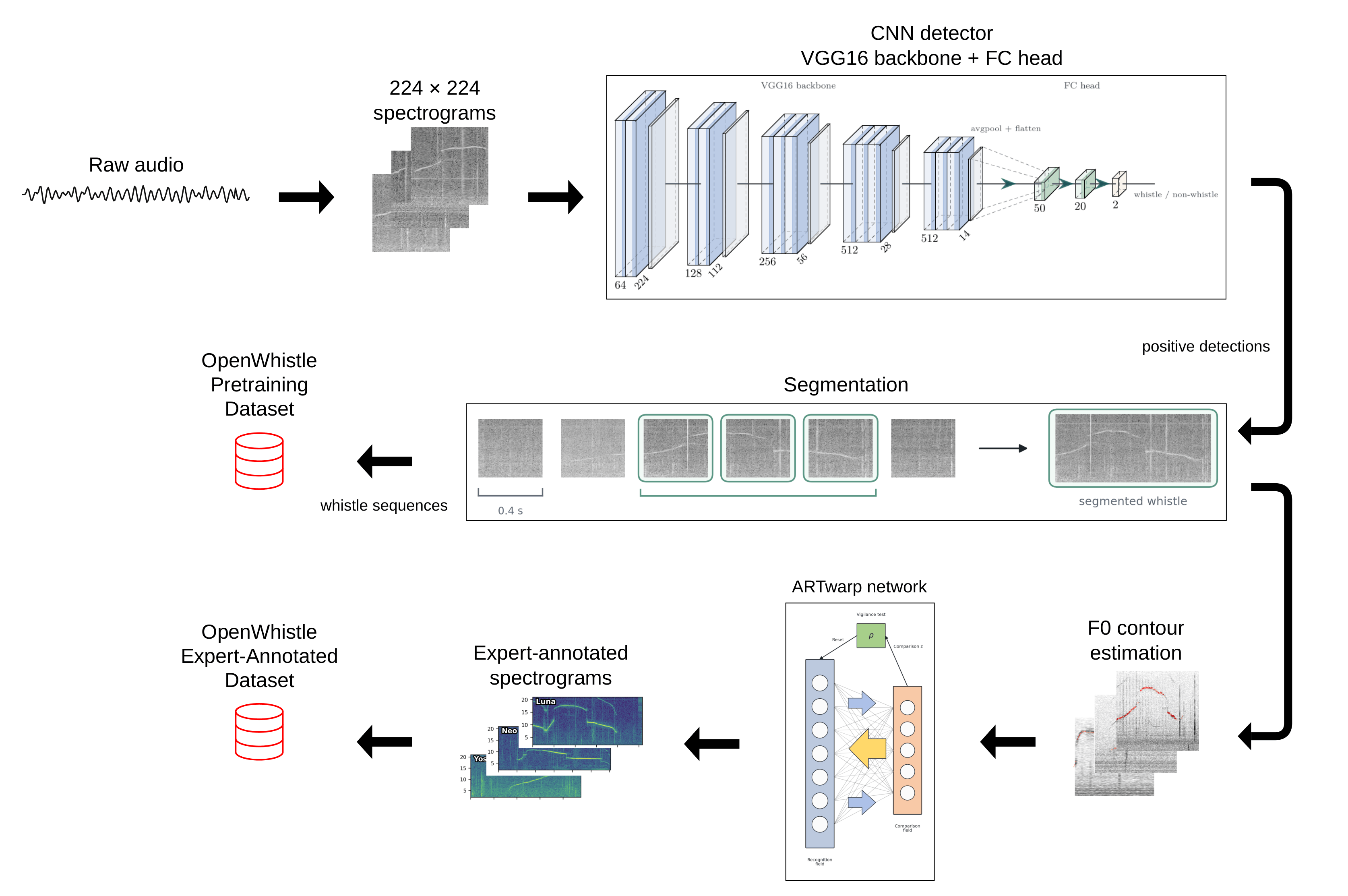
OpenWhistle is the largest publicly available dataset of bottlenose dolphin vocalizations: approximately 180,000 whistles (114 hours) recorded over five years from a stable pod of five individuals in a semi-natural environment. It includes 8,354 expert-annotated whistles, reproducible detection and classification benchmarks, the full processing pipeline, and a Wav2Vec2.0 model pretrained specifically on dolphin acoustics.
C. Semenzin, F. Mustun, R. Dessì, A. Emanuelli, P. Orhan, Y. Lakretz, G. de Polavieja, G. Sumbre.
AI for Non-Human Animal Communication Workshop @ NeurIPS 2025.
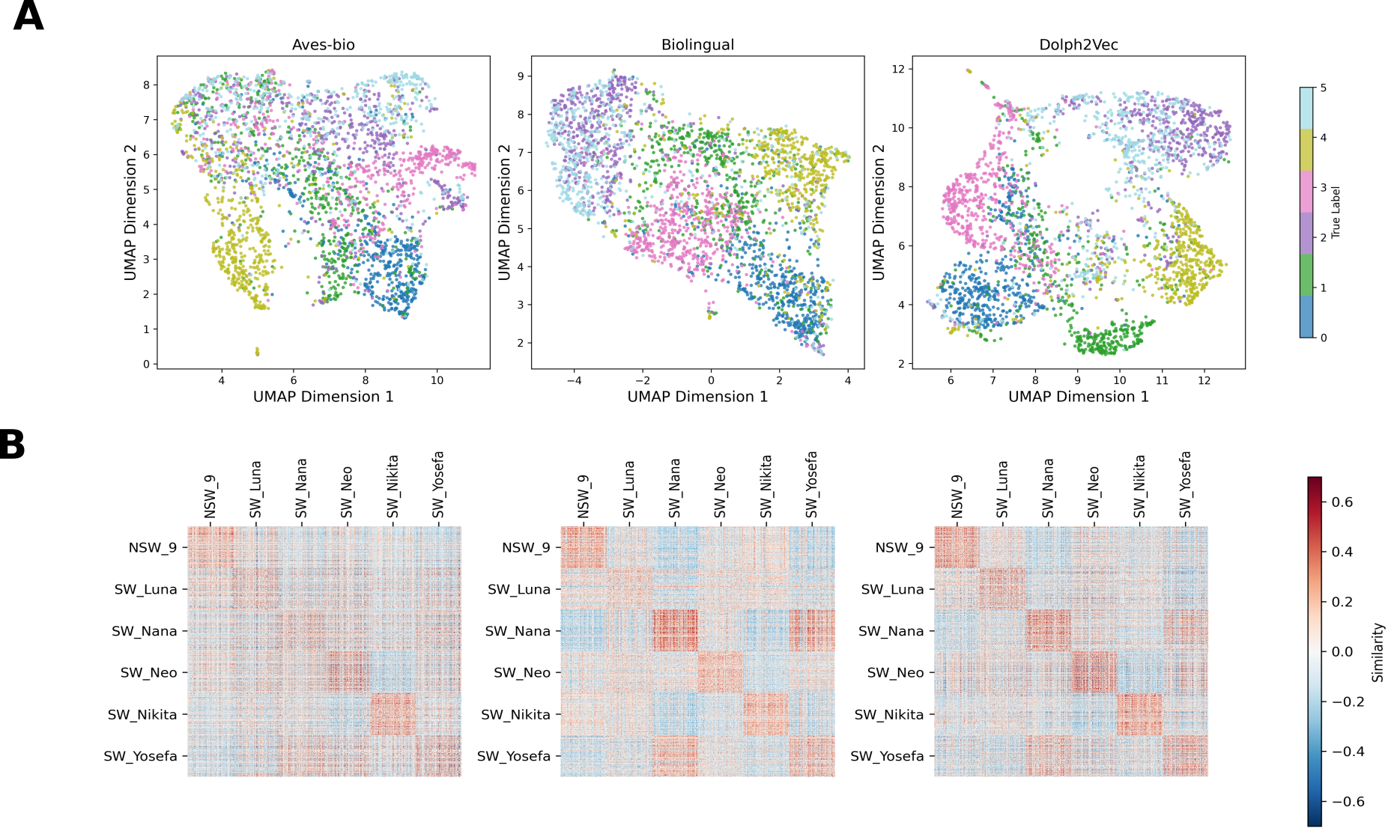
Dolph2Vec is a self-supervised learning framework trained directly on dolphin vocalizations. The learned representations outperform general-purpose bioacoustic embeddings on dolphin-specific tasks and capture biologically meaningful acoustic structure.
F. Mustun*, C. Semenzin*, D. Rance, E. Marachlian, Z. Guillerm, A. Mancini, P. Robin Guerrero, I. Bouaziz, E. Fleck, N. Shashar, G. de Polavieja, G. Sumbre.
* Equal contribution
Advanced Science, revised manuscript under review.
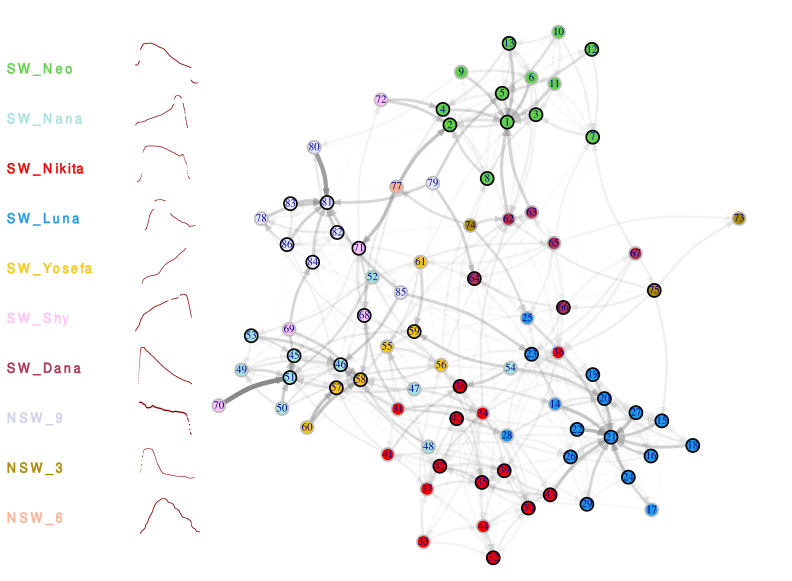
Signature whistles are individual identity signals, but their within-individual variability is not random: it falls into discrete sub-categories defined by stereotyped, localized frequency modulations. Modeling transitions between these sub-categories reveals a modular communication network that mirrors the pod’s social structure, and in which whistle types matching the signature whistles of deceased mothers are embedded within their offspring’s clusters, suggesting whistles may carry information beyond identity.
2025–2026
PSL-Neuro PhD extension funding — Université PSL. Competitive 9-month grant to complete the PhD. Call page
2022–2025
FIRE doctoral fellowship — FIRE PhD program (Doctoral School 474), funded by the Bettencourt Schueller Foundation and the EURIP Graduate School, Université Paris Cité (ANR-17-EURE-0012). Highly competitive: 2–4 fellowships awarded each year out of around 200 applications. EURIP fundings
2018–2019
Accommodation grant — Fondation de France / Cité internationale universitaire de Paris. Covered my accommodation for the full academic year of the final year (M2) of my Master’s degree.
Postdoctoral Researcher, INSERM / IBENS, Paris, France (2026–Present)
Research on dolphin communication, bioacoustics, and machine learning.
PhD Candidate, Institut de Biologie de l’École Normale Supérieure (IBENS), Université Paris Cité, Paris, France (2022–2026)
Research on dolphin communication, bioacoustics, and machine learning.
Statistical Engineer, INSERM / IBENS, Paris, France (2021–2022)
Developed computational methods for dolphin vocalization detection, classification, and sequence analysis.
Data Science Intern, Audentiel Conseil R&D, Boulogne-Billancourt, France (2019)
Worked on hyperparameter optimization and machine learning model selection.
PhD in Cognitive Science, Psychology, Linguistics and Philosophy of Mind — Université Paris Cité / École Normale Supérieure, Paris, 2022–2026
Thesis: From Whistles to Communication: Toward a Computational Understanding of Dolphin Acoustic Signals. Supervised by Germán Sumbre.
Master’s Degree in Applied Mathematics (Specialization: Statistics) — Sorbonne Université, Paris, 2019
Bachelor’s Degree in Mathematics — Université Pierre et Marie Curie, Paris, 2016